









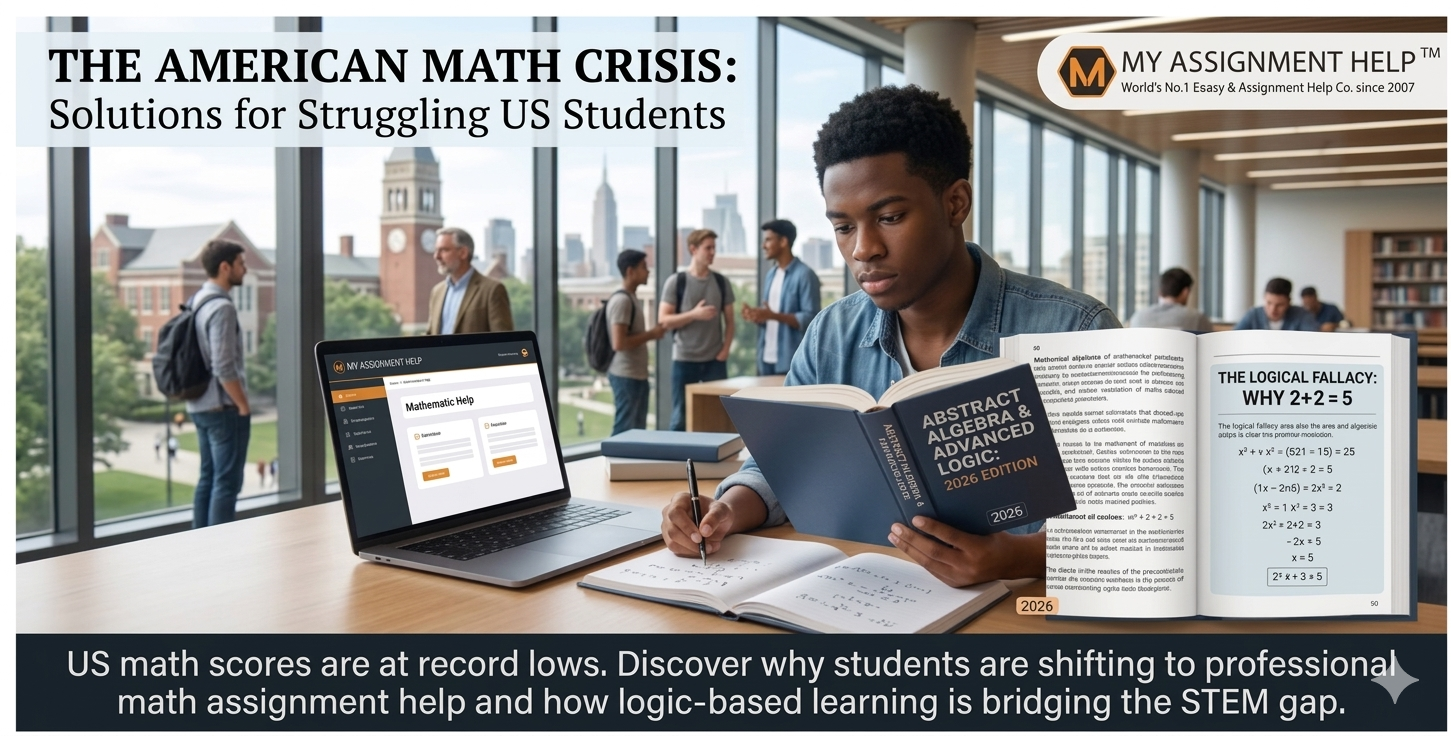
Key Takeaways: 2026 US Mathematics Outlook
- Proficiency Decline: NAEP data shows US math scores at a 20-year low, forcing a shift toward supplemental academic support.
- Regional Complexity: New state-specific standards (e.g., California’s Math Framework and New York’s Regents) are increasing the difficulty for K-12 and College students.
- The Solution: Professional Math Assignment Help is now a primary tool for students to maintain GPAs and meet high-stakes SAT/ACT and GRE benchmarks.
- Logic vs. Rote: Modern education favors logical paradoxes—like the 2+2=5 proof—to build critical thinking over simple memorization.
The Stagnation of Numerical Literacy in the USA
The United States is currently facing a silent but significant challenge in its educational landscape. While STEM careers are projected to grow by 11% through 2030, student proficiency levels tell a different story. From California’s new math frameworks to New York’s Regents exams, the bar for “proficiency” is shifting, leaving many students underprepared for the rigorous demands of US university standards.
In this high-pressure environment, the demand for specialized Math Assignment Help has evolved from a luxury to a strategic necessity. Whether navigating the complexities of Common Core at the K-12 level or tackling Graduate-level GRE math, American students are increasingly utilizing professional platforms to bridge the gap between classroom theory and the technical precision required by modern rubrics.
Beyond Rote Memorization: The Shift to Logical Paradoxes
One of the primary reasons students feel alienated from math is the traditional focus on “getting the right answer” rather than understanding the “why.” Modern US pedagogy is beginning to realize that engaging a student’s curiosity is more effective than repetition.
For instance, the famous 2+2=5 proof is often used in advanced logic classes to demonstrate how shifting axioms can lead to startling conclusions. When students engage with these “mathematical myths,” they develop the critical thinking skills necessary to dismantle complex problems in engineering or data science. By moving beyond the textbook, they begin to see math as a language of logic.
Why Students Seek Professional Math Assignment Help in 2026
The “American Math Crisis” is fueled by three distinct regional factors: home soos, error logic, travel guide, smart home.
- Specialized Regional Rubrics: Each state has unique requirements. Students in Texas dealing with STAAR testing face different challenges than those in New York. A one-size-fits-all classroom approach often fails to address these local nuances.
- The Digital Transformation: Today’s students are digital natives who expect interactive, on-demand support for high-stakes testing like the SAT, ACT, and advanced placement (AP) exams.
- Economic & GPA Pressure: With the average cost of a US degree soaring, failing a single math-heavy course can result in delayed graduation. MyAssignmentHelp has become a vital resource for students needing to meet precise US-specific rubrics to ensure academic progression.
Frequently Asked Questions (FAQs)
Q1: Why are US math scores declining in 2026?
Factors include a shortage of specialized STEM educators and a shift in curricula that many students find difficult to navigate without supplemental 1-on-1 assistance.
Q2: How does professional math help benefit US college students?
It provides localized support that aligns with specific university standards, helping students master complex topics like Linear Algebra, Statistics, and Discrete Math.
Q3: Is the “2+2=5” concept relevant to standard testing?
While not on the SAT, understanding the logic behind such proofs helps students excel in the “Higher Math” sections of competitive exams by strengthening their deductive reasoning.
About the Author
James Sterling is a Senior Academic Consultant at MyAssignmentHelp. With over a decade of experience in the US higher education sector, James specializes in helping students navigate the complexities of modern STEM curricula, from Common Core K-12 to Graduate-level research.